Ahmedabad, August 21, 2026: The Customs, Excise & Service Tax Appellate Tribunal (CESTAT), Ahmedabad, has ruled in favour of several importers in a long-running dispute over the classification of imported lead-bearing material.
The Tribunal held that the Customs Department could not classify the imported goods as “lead waste and scrap” under Customs Tariff Heading (CTH) 7802 on the basis of conflicting laboratory reports and other evidence. The impugned order classifying the goods under Chapter 78 was set aside and the appeals were allowed.
What was the dispute?
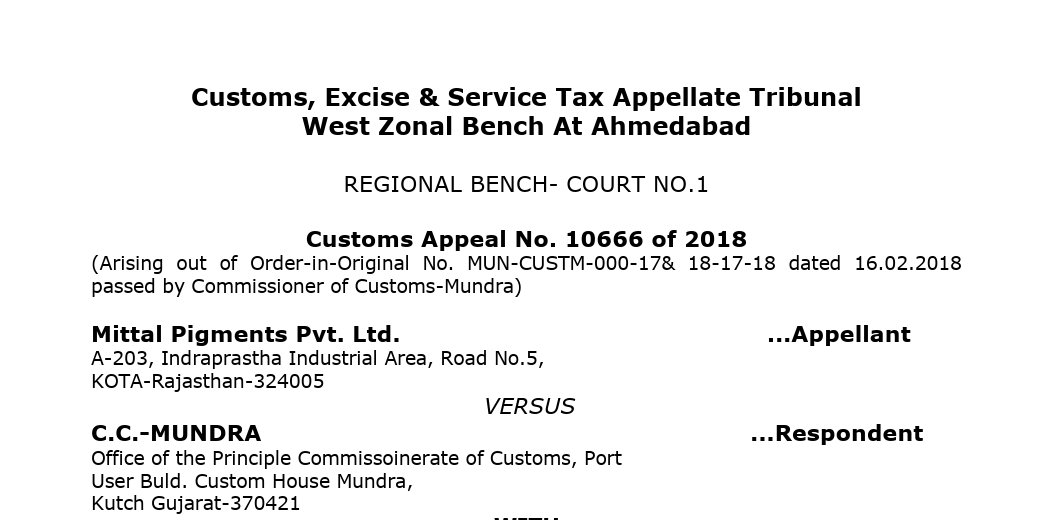
The case involved companies including Mittal Pigments Pvt. Ltd., Jammu Pigments Ltd. and R.G. Pigments Pvt. Ltd.
The companies had imported a powder-like lead-bearing material and declared it as “Lead Concentrate” under CTH 26070000. They claimed the benefit of a concessional customs duty applicable to goods under headings 2601 to 2617.
Customs, however, took a different view. According to the Department, the material was actually waste and scrap obtained from used lead-acid batteries and should have been classified under CTH 7802.
This difference in classification was important because it affected the customs duty as well as the legality of importing the material.
Why did Customs call it battery scrap?
During examination at Mundra Port, the imported material was found in powder form. Samples were sent to different laboratories for testing.
The test results, however, were not uniform.
The Kandla Customs Laboratory found the material to contain around 65.7%–65.8% lead and described it as a material having characteristics of lead concentrate. On the other hand, the Customs Laboratory at Nhava Sheva said that the material was not lead concentrate and had characteristics of used lead-battery scrap.
Samples were subsequently sent to CRCL, New Delhi. Some CRCL reports described the material as resembling washed and dried electrode paste derived from used lead-acid batteries. Other reports, however, produced different findings.
The Department also relied on documents from the exporting country, pre-shipment inspection reports, the nature of the importers’ factories and the type of furnaces used by them.
Importers’ argument
The importers argued that the material should be classified according to what the goods actually were at the time of import, rather than based on the type of machinery available at their factories.
They also pointed out that the laboratory reports were contradictory. Some reports supported their description of the goods as lead concentrate, while others took a different view.
The importers further relied on the earlier CESTAT decision in Gravitas India Ltd. v. Commissioner of Customs, Mundra, where similar goods and similar evidence had been considered. The Tribunal noted the similarity between the two matters.
What did the Tribunal find?
The Tribunal examined the competing evidence and found that the Department’s case could not be sustained.
An important point was the chemical composition of the material. The Tribunal noted that the samples primarily consisted of lead sulphate and lead oxide, with practically no lead in metallic form.
The Tribunal observed that if the material was not accepted as “lead concentrate”, the Department’s proposed classification under CTH 7802 still could not be justified. The Tribunal noted that the material could potentially fall under other provisions of Chapter 28, which covers certain chemical substances, rather than Chapter 78, which concerns lead in metallic/primary form.
In simple words, Customs could not simply call the material “lead scrap” when the laboratory evidence did not establish that it was metallic lead waste or scrap covered by Heading 7802.
Conflicting laboratory reports became a key issue
The Tribunal also took note of the conflicting laboratory findings.
Rather than deciding the case solely on the question of which laboratory should be believed, the Tribunal found that the Department’s proposed classification under Chapter 78 itself was not sustainable on the evidence available.
The Tribunal specifically stated that, because the Department’s classification was not applicable to the goods, it was not necessary to decide all the other arguments concerning the sampling process and the conflicting reports.
Supreme Court had earlier sent the matter back
This was not the first time the dispute reached the Tribunal.
In the earlier round, CESTAT had decided the matter in favour of the party. The Customs Department challenged that decision before the Supreme Court.
The Supreme Court, in Commissioner of Customs, Mundra v. Mittal Pigments Pvt. Ltd., set aside the earlier Tribunal order because it did not adequately deal with the rival submissions and remanded the matter to CESTAT for a fresh decision.
The Ahmedabad Tribunal therefore heard the matter again and considered the submissions of both sides.
Final decision
After examining the evidence, the Tribunal concluded that the Department’s case could not be sustained.
The order classifying the goods under Chapter 78 as lead waste and scrap was set aside, and the appeals were allowed. The Tribunal also held that the classification declared by the parties deserved to remain undisturbed.
The order was pronounced in open court on August 21, 2026, by Somesh Arora, Member (Judicial), and A.K. Jyotishi, Member (Technical).
Why this judgment matters for importers
The decision highlights an important point for importers: customs classification cannot be based merely on assumptions about how the goods were produced, what machinery an importer uses, or how similar goods may have been described in other documents.
The actual nature and characteristics of the imported goods and the applicable Customs Tariff provisions remain central to classification.
For businesses dealing in metals, minerals, recycling materials and industrial waste, the ruling also shows why accurate product descriptions, proper laboratory testing and correct tariff classification are extremely important.
This article is based on Final Order No. 10545-10567/2026 of CESTAT Ahmedabad, pronounced on August 21, 2026.