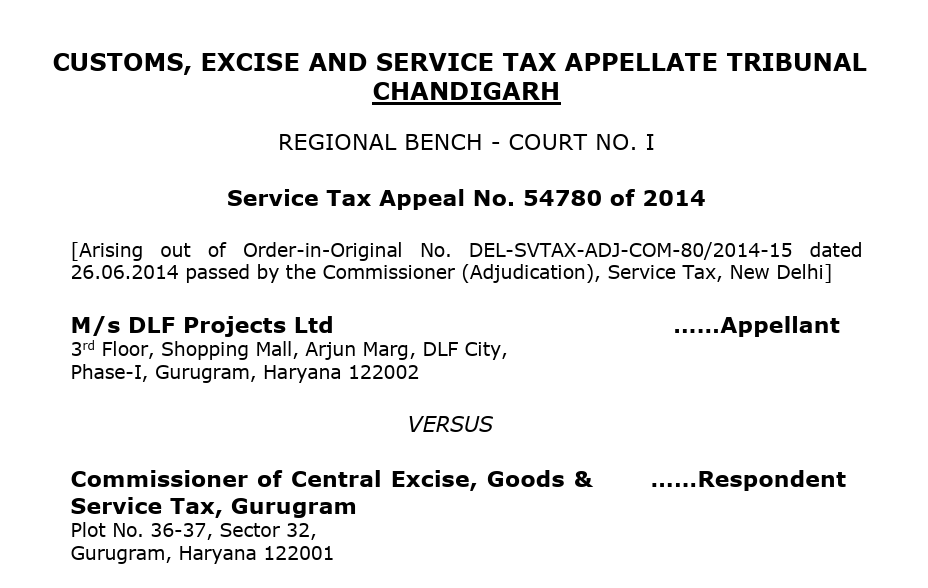
New Delhi, August 21, 2026: The Customs, Excise and Service Tax Appellate Tribunal (CESTAT), Chandigarh, has given major relief to DLF Projects Ltd. in a long-running service tax dispute.
The Tribunal set aside penalties imposed on the company for alleged short-payment of service tax, holding that there was a genuine legal uncertainty about which valuation scheme applied to its ongoing construction projects. The Tribunal also dismissed the Revenue Department’s appeal challenging the original order.
What was the dispute?
DLF Projects was engaged in the construction of residential and commercial projects. Some of its projects had started before June 1, 2007, but construction continued after that date.
From June 1, 2007, the government introduced a Composition Scheme for valuation of service tax on certain works contract services. DLF Projects applied this scheme to some of its ongoing projects, including projects that had actually started before June 1, 2007.
The Service Tax Department disagreed with this approach.
According to the Department, projects that had started before June 1, 2007 could not use the new Composition Scheme. As a result, the Department believed that DLF had paid less service tax than it should have.
How much tax was involved?
During the proceedings, the tax liability was recalculated based on information provided by DLF and supported by a Chartered Accountant’s certificate.
The differential service tax worked out to approximately ₹3.57 crore.
DLF paid this amount along with approximately ₹1.49 crore in interest. It also reversed CENVAT credit of about ₹74.19 lakh, along with applicable interest. Importantly, these payments were made before the Commissioner passed the final adjudication order.
However, despite the payment, penalties were imposed under Sections 76 and 77 of the Finance Act, 1994.
That is what DLF challenged before CESTAT.
Why did DLF ask for the penalties to be removed?
DLF argued that it had not deliberately avoided paying tax.
The company said there was a genuine uncertainty about the correct valuation method for ongoing construction projects. The legal position became clear only after the Supreme Court’s judgment in Nagarjuna Construction Company Ltd. v. Union of India.
Once the legal position became clear, DLF immediately paid the differential tax and interest and reversed the required CENVAT credit.
In simple terms, DLF’s argument was:
“We were not trying to evade tax. There was confusion about the law. Once the law became clear, we paid the amount.”
What did CESTAT say?
The Tribunal agreed with DLF.
CESTAT observed that the dispute involved the interpretation and applicability of the service tax valuation scheme, and that the issue received final clarity only after the Supreme Court’s decision.
Because of this uncertainty, the Tribunal held that DLF had a “reasonable cause” for initially paying the lower amount of service tax.
Under Section 80 of the Finance Act, 1994, a taxpayer could avoid penalties under Sections 76 and 77 if it could establish that there was a reasonable cause for the failure.
The Tribunal found that DLF satisfied this requirement.
Penalties set aside
Based on these findings, CESTAT held that the penalties imposed under Sections 76 and 77 were not legally sustainable.
The Tribunal therefore allowed DLF Projects’ appeal and completely set aside the penalties.
Revenue Department’s appeal also dismissed
The Revenue Department had filed a separate appeal against the same order.
The Department argued that the Commissioner had relied too heavily on the Chartered Accountant’s certificate and had not properly examined certain income and differences in the service tax figures.
CESTAT rejected these arguments.
The Tribunal found that the Commissioner had properly examined the records, including:
- CENVAT records;
- GAR-7 challans;
- CENVAT credit reversal details;
- reconciliation statements; and
- Chartered Accountant certificates.
The Tribunal concluded that the Commissioner’s order did not suffer from any legal or factual error and therefore dismissed the Revenue’s appeal.
Final decision
CESTAT Chandigarh passed the following decision on August 21, 2026:
DLF Projects’ Appeal – Allowed
Revenue’s Appeal – Dismissed
Penalties under Sections 76 and 77 – Set Aside